Stop “Hedging” Your Success: How Small Words Undermine Your Professional Impact
Have you ever started an email with “I’m just checking in…” or commented on a discussion in a meeting with “I’m no expert, but maybe we could try this”?
In the moment, these phrases feel like politeness. It’s our way of not sounding too self-sure. We use these little phrases to soften a request, avoid sounding “bossy,” or protect ourselves when there’s a risk we might be declared wrong. However, in the professional world, these phrases are known as “Hedges” and they are quietly diluting your impact and authority.
Learning to spot these hedging phrases in your day-to-day writing and speech is the first step toward reclaiming your professional voice.
What is Hedging in Communication?
Hedging language consists of “qualifiers” and “softeners” that limit the certainty or strength of a statement. While they have a place in casual conversation, using them in a business setting can make you appear hesitant, unprepared, or lacking in confidence.
The Culprits: Common Words That Diminish Your Impact
Take a look at how these four common qualifiers change the “vibe” of your message and weaken your assertive communication.
1. “Just” — “I just wanted to see if you’ve finished.”
Using “just” makes your request feel like an apology or an interruption.
2. “Slightly” or “A bit” — “I’m slightly concerned about the deadline.” “I’m a bit concerned that ….”
If there is a risk, “slightly” or “A bit” trivialises the risk or minimises the problem. It risks that others will ignore the warning.
3. “Almost” — “I almost think we should pivot.”
This suggests you aren’t fully committed to your own professional judgment.
4. “Maybe” — “Maybe we should meet on Tuesday.”
This turns a clear direction into a suggestion that is easily dismissed.
Why We Use Weak Qualifiers
We often use these words as a verbal shield. If we say “maybe,” we feel we aren’t “wrong” if the idea fails. If we use “just,” we feel like less of a burden.
Effective leadership and clear communication require directness. When you remove the padding, you sound more confident. This makes it easier for others to trust your expertise and follow your lead.
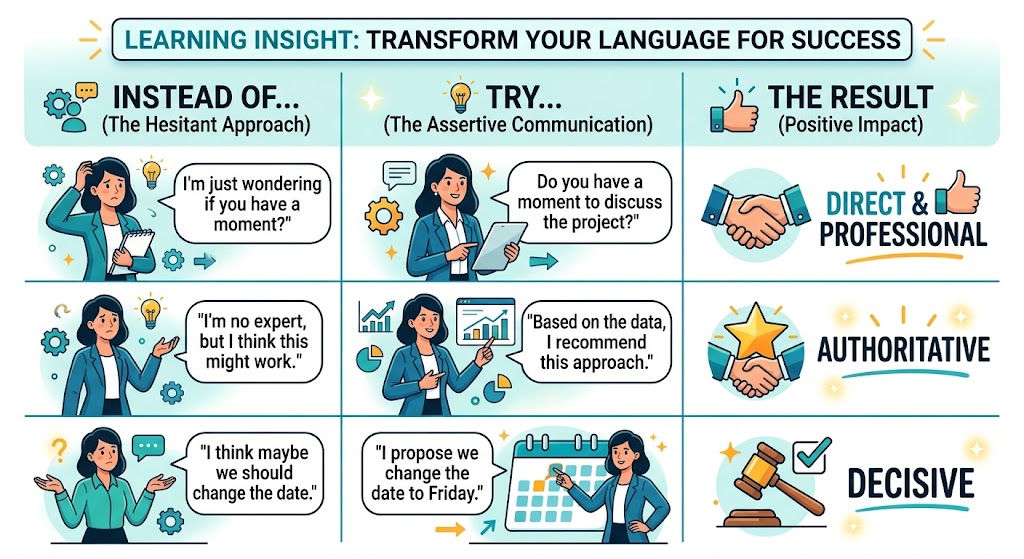
How to Speak with Greater Influence
The shift is simpler than you think. It’s not about being aggressive; it’s about using positive language to be clear and concise.
—
Ready to stop using hedging phrases and master the art of positive communication?
If you find yourself over-using qualifiers or want to learn how to frame your ideas more effectively, it’s time to shift your communication style for better results.
Learn how to command a room (and an email inbox) by enrolling in our online course Positive Language for Positive Results.
For in-house training information, download our PDF course outline for the Using Positive Language for Positive Results workshop.
We’ll dive deep into the impact our choice of words has on the impression we make and results we get. We offer practical tools to help you swap “hedging” for “authority,” build trust, drive action, and communicate with purpose.
—
Liz Paine
Founder of Learning Insight
Phone: 0400 778807
Email: Contact form

You may also like

Perspective Is Everything: The Shoe Factory Parable